Driver engineering and standalone game testing on Steam Frame: Snapdragon 8 Gen 3, Adreno A750, SteamOS ARM64, Proton/FEX and multi-queue Turnip. This is the working record: what was built, what was measured, and what is still unproven.
The unified 5-pillar Turnip build (MQca5ec87b, ARM64 library SHA-256 eb96d3fe…) completed its full native Adreno A750 silicon validation gate (G0 through G4) on Steam Frame with zero GPU or DPU faults.
Every one of the 77 GPU processes verified via LD_DEBUG=files that it loaded the exact staged library (77/77 LOADED_OK), with TU_PUSH_UBO_SPECULATE=0 and TU_CS_ISZ_RESTORE=0x20 enforced throughout, untraced only, and dmesg fault delta 0.
On live Adreno A750 silicon inside sr_autotune: - Under TU_DX12_PROFILE=1 (PROFILED), pass hash 219f78fa660bf2ff measured hardware gmem_us=71 (n=8) versus sys_us=58 (n=16) via RB_DONE_TS, driving sys_prob smoothly to 99 % SYSMEM. - Under TU_SR_AUTOTUNE=bandwidth, the same pass switched from SYSMEM (2 warmup frames) to 22/24 GMEM once sample bandwidth crossed threshold (sys_bw=5,308,416 vs gmem_bw=589,824). - Cross-CB suspend/resume forced SYSMEM 4/4 in every mode, and TU_SR_AUTOTUNE=1 without TU_ELIDE_RP_SR forced SYSMEM on 16/16 same-CB resumed passes as required.
native silicon validation proves correctness, determinism and absence of GPU faults on Adreno A750 under synthetic and conformance suites; it is not a game speedup claim or visual-acceptance proof. Normal adopted default driver stays MQ771, and TU_RT_OPT=1 is not yet folded into this build.
Next: benchmark MQca5ec87b under TU_DX12_PROFILE=1 in Cyberpunk 2077 against Stock SteamOS Turnip and the multi-queue baseline, then run mirrored AC8 VR A/B checks.
Pillars 4 through 6 extend the general Direct3D 12 and Unreal Engine 5 driver stack beyond scalar shader compilation to eye-tracked variable-rate shading, hardware-timed GMEM/sysmem selection, and hardware ray tracing.
Previously, foveated VRS required hard-coding render-target dimensions (TU_VRS_DIMS) for each game and dynamic-resolution scale. TU_VRS=auto replaces manual dimension lists with automatic eligibility detection for main color passes and a bounded LRU VRS map cache that adapts to dynamic resolution scaling. It preserves application-provided fragment shading rate attachments on traditional render passes, rejects per-layer render areas and MSRTSS, and falls back cleanly to full-rate shading whenever gaze shared memory is absent.
Tile-based GPUs lose substantial bandwidth if vkd3d-proton suspend/resume render passes pick the wrong binning mode. Pillar 5 adds a PROFILED autotuner driven by real Adreno RB_DONE_TS hardware timestamps (plus an optional bandwidth heuristic mode): - Measures actual GMEM versus SYSMEM render-pass duration per pass hash and converges probabilistically toward the faster path. - Fixes cross-command-buffer suspend/resume hazards (is_cross_cb_sr forced to SYSMEM before single-prim and GMEM overrides) and enforces SYSMEM on same-CB resumed passes whenever TU_ELIDE_RP_SR is disabled.
Unified opt-in profile (TU_DX12_PROFILE=1|vr)
All five unified pillars sit behind a single opt-in umbrella in MQca5ec87b: - Unset / 0: 0 bytes hashed into the cache UUID; 100 % byte-identical to MQ6a3f65d. - TU_DX12_PROFILE=1 (flat games): enables TU_UBO_WITNESS_HOIST=1, TU_UE5_SAFE_FP16=1, TU_ELIDE_RP_SR=1, TU_ELIDE_CLEAR=1, TU_ELIDE_PRIME=auto, TU_SR_AUTOTUNE=1, TU_SG32_EMU=v2, and TU_UBWC_3D=1 (leaving VRS off). - TU_DX12_PROFILE=vr: adds TU_VRS=auto. Every individual knob remains independently overridable.
Pillar 6: General HWRT / ray-query optimization (TU_RT_OPT=1)
Built in parallel on the same MQ6a3f65d base (keeping the MQa267488 H-PLOC acquire barrier and bounded BVH encoder wait untouched), TU_RT_OPT=1 adds six spec-sound ray-tracing optimizations: command-buffer preamble hoisting, redundant per-raygen handle check elision under CP_COND_REG_EXEC, sound push-descriptor UBO witnessing for RT variants, shared trace_rq storage with dead-field liveness kills (33 full registers killed at lower_rq_initialize), per-trace-site hit-state bitmasks, and skipping a redundant refit barrier in tu_update_as.
Overall, 16/44 variants gained wave occupancy and 10/10 spilling variants cut register spills by 63 % to 100 %.
TU_RT_OPT=1 is currently verified offline on 44 Adreno A750 ray-tracing pipeline variants and has not yet been merged into the gated unified binary or timed in live Lumen cinematics. Pillars 4 and 5 have passed offline drm-shim checks and are queued for native A750 silicon validation, not yet live game A/B benchmarking.
Next: run the full native Adreno A750 gate (G0–G4) on the unified 5-pillar build and then benchmark live DX12 games under TU_DX12_PROFILE=1 and vr.
After closing the game-specific shader work in Ace Combat 8, driver work shifted to game-agnostic Direct3D 12 and Unreal Engine 5 optimizations in Turnip with zero game shader hashes and TU_PUSH_UBO_SPECULATE=0 throughout. Pillars 1 through 3 address three general bottlenecks seen across vkd3d-proton workloads.
vkd3d-proton binds constant buffers through partially-bound descriptor sets, which prevents the compiler from hoisting uniform loads out of loops or conditional regions unless access is proven safe. Pillar 1 adds stage-generalized forward must-access dataflow and region-witnessed LICM hoisting in NIR without speculating across unwitnessed descriptors.
Across 55 active UE5 compute, fragment and vertex shaders compiled for Adreno A750: - 16 shaders changed, 1,804 UBO loads promoted (30 loop hoists, 27 region hoists). - cat6 memory instructions fell from 1,595 to 1,515 (−80), main-body ldc from 1,012 to 932 (−80), and sy sync stalls from 1,444 to 1,400 (−44). - Zero new spills, zero wave occupancy regressions, and zero occurrences of TU_PUSH_UBO_SPECULATE.
A manual FP16 pass in an earlier UE5 test broke volumetric clouds because world-space distances above 65,504 overflowed half-float comparison predicates. Pillar 2 moves FP16 relaxation into Turnip's NIR pipeline with explicit safety guards: - Taints comparison and branch predicates, exact ALU ops, indirect outputs, >11-bit UNORM/SNORM render targets, and PIPE_FORMAT_NONE storage writes (keeping DenormPreserve 16 compliant on pre-A8xx hardware). - Enforces an A750 occupancy guard so lowering is accepted only when it improves register pressure without adding spills. - Across the 55-shader audit (NIR_VALIDATE=1), 8 fragment shaders were lowered cleanly (0/50 new half-float cmps.f, 0/50 new spills, 1,805 half-ALU ops) and 5 compounded directly with Pillar 1 — for example reducing one translucency shader from 16 full registers (768 fibres) to 12 (1,024 fibres, +33 % occupancy).
vkd3d-proton emits dynamic rendering SUSPENDING → RESUMING chains that broke UBWC and LRZ fast-clear and prime-elision paths. Pillar 3 unifies empty-pass, clear, and prime elision (TU_ELIDE_RP_SR=1, TU_ELIDE_CLEAR=1, TU_ELIDE_PRIME=auto) onto MQ6a3f65d, snapshotting Pass 1's raw VkAttachmentLoadOp and recomputing resumed pass ops while rejecting memory-writing shaders and invalidating cleanly on MSRTSS.
With all knobs unset, all 55 shaders and 339 offline RD captures remain 100 % byte-identical to parent MQ6a3f65d.
shader instruction counts and wave occupancy numbers come from offline Adreno A750 compilation of 55 active UE5 shaders plus drm-shim command-stream checks; live game timing and visual reviews for these general pillars have not run yet, and no game speedup is claimed from compiler counts alone.
Next: pair these three pillars with zero-config gaze VRS, SR-aware GMEM autotuning, and HWRT optimization, then run the full native A750 silicon gate.
Full-screen UI glow and blend passes cover an entire stereo render target even when HUD elements occupy only a small fraction of the screen. In MQ6a3f65dc85 (hudmask v3, opt-in TU_HUD_MASK=1), Turnip computes an exact per-tile occupancy mask on the GPU and skips empty 64×64 tiles before shading AdditiveGlowPS and SoftLightPS.
Implementation details
Dynamic rendering suspend/resume: supports vkd3d-proton's same-command-buffer SUSPENDING and RESUMING(LOAD) render passes without dropping tile state.
Descriptor discovery: derives vertex and fragment UBO bindings directly from NIR and handles VK_DESCRIPTOR_TYPE_MUTABLE_EXT bindless heaps.
Bit-exact off path: with TU_HUD_MASK unset, command-stream output is byte-identical to parent MQfda6079.
Native silicon gate and live Ace Combat 8 timing
Native Adreno A750 validation (G0–G4) passed with zero faults: 16/16LOADED_OK, CTS6349/14, native1913,224/0, 9/9 CRC pairs bit-identical across 35 test cases, 4,000/4,000 soak/flip iterations, and 8/8 RD captures byte-identical with pm4lint=0.
In live Ace Combat 8 VR (90 Hz, 4-process mirrored ABBA across 38,694 masked passes, all 32/32 windows locked at 903 MHz):
Metric
Delta (ON vs OFF)
95 % CI
Heavy-segment GPU busy
−0.549 ms/frame
[−0.855, −0.243]
Pooled GPU busy
−0.297 ms/frame
[−0.513, −0.081]
Light-segment GPU busy
−0.045 ms/frame
[−0.351, +0.261]
Heavy xrWaitFrame p50 (pacing)
−0.624 ms/eye
—
Heavy 3-vsync share
+1.64 pp (17.8 % fewer misses)
—
The blind visual review passed 44/44 (8/8 positive controls caught, 20/20 null pairs judged neither, 16/16 live ON/OFF pairs judged neither). Across more than 55,000 masked passes in flight, zero GPU faults and zero mask errors occurred.
TU_HUD_MASK=1 targets two specific full-screen HUD glow and blend passes (AdditiveGlowPS and SoftLightPS) rather than general DX12 shaders; it has only been measured in Ace Combat 8 and native tests, and final in-headset visual acceptance (M4) is still pending. Traced runs remain on MQfda6079, and the normal adopted default driver remains MQ771.
Next: build game-agnostic DX12 and UE5 driver optimizations on top of MQ6a3f65d.
All Steam Frame Direct3D 12 and Unreal Engine 5 work runs on a multi-queue Freedreno Turnip lineage built on top of the MSM kernel driver, rather than falling back to older single-queue revisions. Every bug fix and optimization is carried forward on the same tree and verified by loaded library SHA-256 on device.
Stability fixes carried across the lineage
**VM_BIND publication (MQ771, 771d981e)**: fixed virtual-memory binding publication races on multi-queue submissions. This revision passed native validation (CTS6349 pass / 14 expected unsupported, native1913,224 assertions) and remains the normal adopted default driver.
**Embedded-sampler and command-stream lifetime (MQ2cc43d3 / MQ6ed0c13)**: root-caused a GPU page fault where in-flight draws read embedded_samplers buffer objects after the application destroyed pipelines or root signatures. Command buffers now hold embedded-sampler descriptor set layouts, paired with bounded command-stream BO retention and vkd3d-proton PSO retention.
**Conservative push-UBO and CS_ISZ invariants**: TU_PUSH_UBO_SPECULATE stays disabled (0) across all profiles because speculating across partially-bound descriptors bypasses conservative compiler handling. TU_CS_ISZ_RESTORE=0x20 is preserved throughout.
**H-PLOC BVH handoff and bounded encoder spins (MQa267488)**: resolved a level-load GPU hang (msm hangcheck recovery on RHIThread) by adding the missing H-PLOC acquire barrier, bounding BVH build and encode spin loops, and adding an opt-in TU_AS_VALIDATE validator. Six consecutive level loads ran clean with zero validator violations.
**u_trace flush lock (MQfda6079)**: reproduced a native crash in u_traceprocess_flush under concurrent submissions and fixed the race. On a paired untraced A/B test, MQfda6079 matched MQa267488 within noise (+0.058 ms/f, 95 % CI [−0.022, +0.123]), allowing traced diagnostics to resume on that child while keeping tracing disabled on earlier builds.
Every subsequent driver experiment branches from this hardened base, keeping TU_PUSH_UBO_SPECULATE=0 and verifying zero kernel GPU or DPU faults across every gate run.
the normal adopted default driver remains MQ771; child fixes on MQa267488 and MQfda6079 are validated on native silicon and Ace Combat 8 workloads, not as a universal DX12 stability proof. The H-PLOC BVH fix recorded zero recurrence across six consecutive level loads rather than a formal proof of closure, and traced windows remain banned on every multi-queue child except MQfda6079.
Next: land general DX12/UE5 optimizations on top of this lineage without falling back to single-queue Turnip.
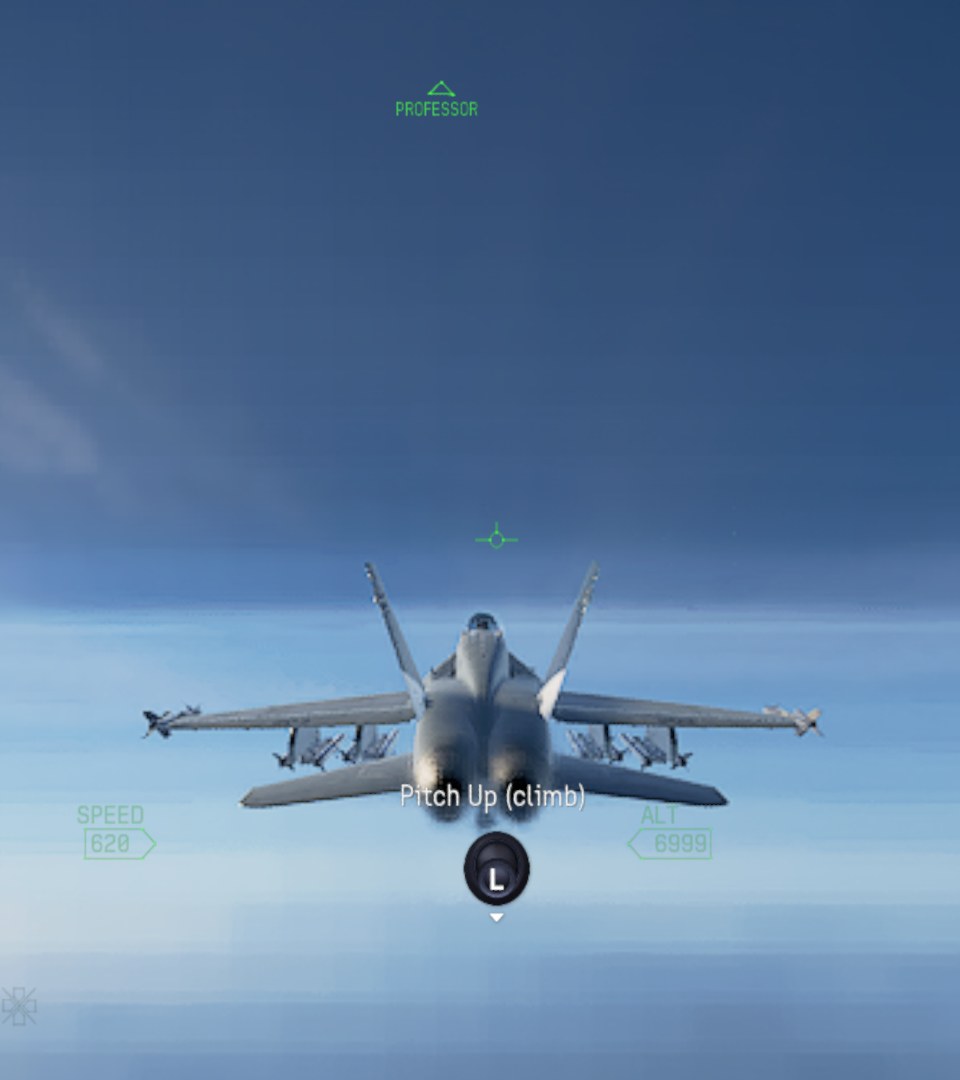
Single-eye VR compositor capture from QV86 in-flight verification on Steam Frame (90 Hz, clean 9-target shopt86 + hudmask v3 + eye-tracked VRS active).
QV86 extended shader and cloud optimizations to both flight and Lumen+HWRT cinematics, recording zero GPU or DPU faults across all 18 launches on the boot and setting a new stacked flight record.
The flight gain came from a clean 9-target FP16 hot-swap set (shopt86: pm_31d9=gidf_fp16, tonemap=l15_fp16, shopt86_gbuf=fp16). Across a 4-process crossed flight+bench ABBA (9,369 flight + 7,156 bench frames), it cut heavy GPU busy by −0.411 ms/frame (95 % CI [−0.672, −0.151]), pooled GPU busy by −0.271 ms/frame ([−0.455, −0.087]), and heavy 3-vsync misses by 22 % (+1.34 pp), passing blind visual review 52/52 (8/8 controls caught, 0/28 candidate worse).
Stacked across all four cinematic windows (B86_1 + B86R_1 vs QV85), mean p50 dropped **−2.26 ms/eye** (56.67 / 65.93 / 47.16 / 64.52 ms/eye) and GPU busy dropped **−2.14 ms/frame** (53.57 / 59.19 / 46.03 / 54.84 ms/frame).
The FP16 predicate overflow catch
A tenth shader candidate (tu=trim_fp16 on TemporalUpscaleCS) saved −0.549 ms/frame in flight, but the 80/80 blind review rejected it with 11 severe flags: grid-aligned rectangular blue cutouts in volumetric clouds. Root-cause analysis showed 42 relaxed float values feeding OpBranchConditional comparison predicates where world-space cloud distances above 65,504 overflowed FP16. That defect was immediately dropped from QV86 and directly motivated the predicate-tainted TU_SAFE_FP16 compiler pass now built into Turnip.
xrWaitFrame p50 and 3-vsync share are aggregate pacing numbers, not a GPU pass breakdown. Clean shopt86 in cinematics measured NULL (−0.183 ms/f, CI [−0.480, +0.150]) and was not adopted there; M4 in-headset visual acceptance remains pending.
Next: test the general 5-pillar Turnip driver (MQca5ec87b) and HWRT compiler path (TU_RT_OPT=1) against this QV86 baseline.
Stacking the exact GPU HUD tile-mask driver (MQ6a3f65dc85, TU_HUD_MASK=1), the flight-and-deck 5-shader hot-swap stack (tr1v), the cut-black v5 backend (cbrh5), and the target lock-box runtime met and replicated the M1 target (≥95 % of frames landing on 3 vsyncs at 90 Hz).
What went into the tr1v 5-shader stack
Targeted pure-FP32 compute and translucency optimizations (comp_atm=cse, fsrpi=fe15, clsh=s2, vtps=ed, abps=ed; cinematics left on baseline) passed 52/52 in blind review (8/8 positive controls caught, 0/28 clear or severe regressions). A quadAll early-out variant (vtps=edq) was rejected after the blind review caught a horizontal contrail cutoff under TU_VRS=1 at a 4×4/2×2 shading-rate boundary.
Compared to the QV77 baseline (30.83 ms/frame GPU busy), the stacked build dropped 0.93 ms/frame of GPU busy time with 0 / 3,538 frames above 50 ms, 4/4 target-container materials flipped (errors=0), and 0 GPU or DPU faults across all 10 launches on the boot.
Cinematics (CIN1–CIN4, Lumen + HWRT enabled, 0 compositor drops) measured 49.67–67.56 ms/eye p50 and 48.45–60.96 ms/frame GPU busy.
aggregate xrWaitFrame p50 and 3-vsync share reflect wall-clock frame pacing, not a per-pass GPU breakdown. Cinematics with Lumen and HWRT still run at 49.7–67.6 ms/eye p50 (48.5–61.0 ms/f GPU busy), and M4 in-headset visual acceptance is still pending.
Next: push flight headroom further and attack cinematic Lumen/HWRT GPU busy time without losing visual fidelity.
Raw frame pacing is meaningless if stereo VR breaks HUD targeting or flashes black frames between camera cuts. Three correctness items were closed and verified before the final stacked benchmark.
Cut-black v5 backend (cbrh5)
Story cinematics and deck transitions emit brief black cut frames that caused jarring stereo flashes in VR. The v5 UEVR backend (cbrh5) holds black cut frames directly on the GPU behind a view-target gate so no pass runs during flight (+0.015 ms/frame bench cost). - **Blind visual review (cb81)**: 70/70 PASS (10/10 positive controls caught including real black cut frame cin-31, 0 severe flags against candidate). - Live verification: held 34/34 cinematic plus 2/2 deck black cut frames in B85_1 (32/32 cinematic plus 4/4 deck in B85R_1), with 0 released black frames and 0 flight holds.
Target lock box (FLAG + HOLD h05)
An earlier shader workaround (C2D) was rejected after proving the apparent vertical offset belonged to a second drone's own box, and that selected targets blink 0.2 s on / 0.2 s off by design. The adopted fix is a standalone UEVR Lua runtime implementing route A FLAG + HOLD h05 (41/41 Lua unit tests pass, leaving permanent startup files untouched). - **Near range (lb4j3-1)**: 55/55 blind PASS (11/11 controls, 6/6 displaced-box detections, stereo 3/3 + 3/3). - **Paired GPU cost (LB4C_1 ABBA)**: −1.004 ms/frame (95 % CI [−1.056, −0.952]), verified legitimate via restored empty-layer checks. - **Far range (4.7 km) and unfrozen pursuit motion (lb4m2)**: 62/62 blind PASS (100 % across all metrics, 4,698 m far target, 10/10 motion tracking, 5/5 motion match).
Zero-hitch audit
Pooled across 12 untraced U0 flight processes (21,046 presented frames): - **0 / 21,046** frames exceeded 100 ms (0 shader-compile stalls, 0 multi-frame freezes). - **6 / 21,046** frames (0.029 %, max 80.08 ms) exceeded 50 ms, all 6 traced to single-frame zram swap-in major page-fault bursts.
automated blind visual reviews and scripted pursuit/far-range tests passed at 100 %, but final in-headset visual acceptance (M4) still awaits a human look inside Steam Frame. Six single-frame >50 ms spikes in the 21,046-frame audit came from zram swap-in major page faults rather than shaders.
Next: combine the M2 correctness stack with the GPU HUD tile-mask driver and 5-shader flight stack to replicate M1 (>=95 % on 3 vsyncs).
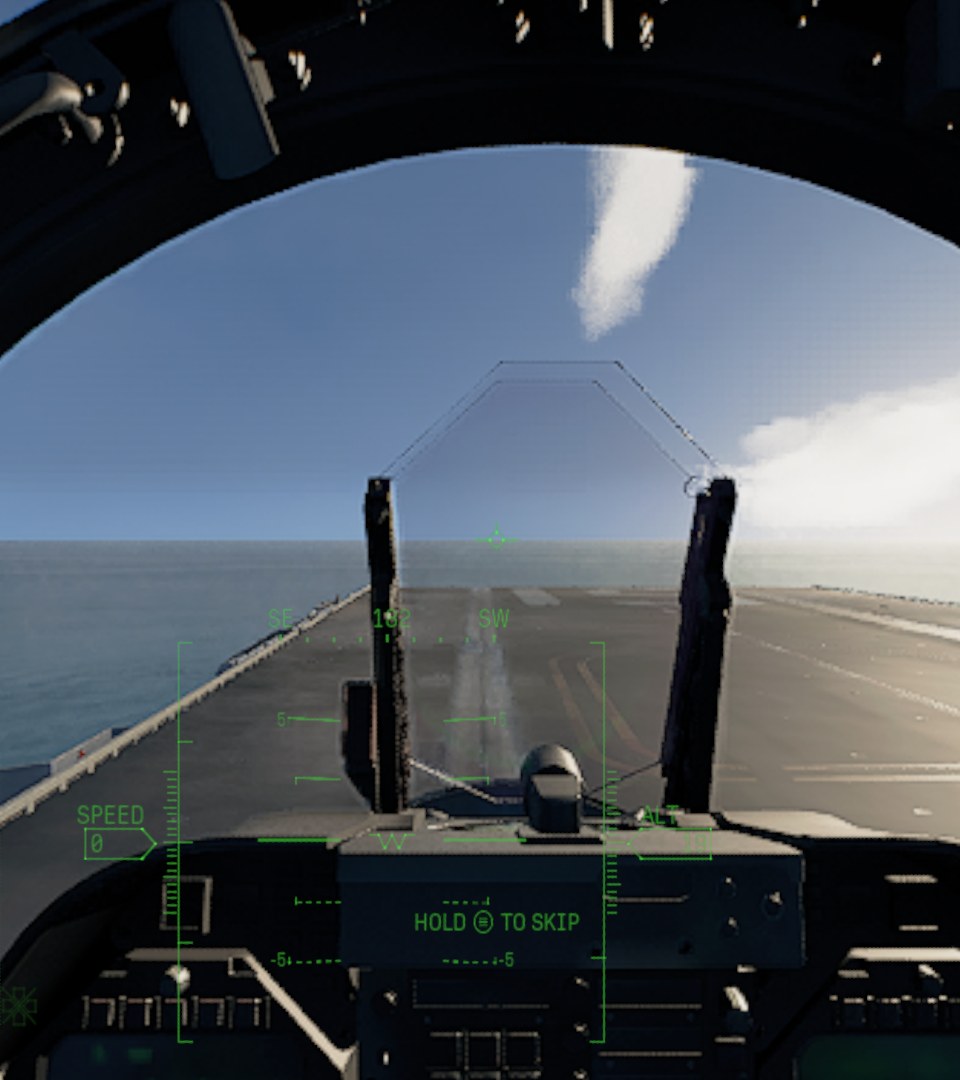
Single-eye VR compositor capture from the carrier deck on Steam Frame (1020×508 SBS FSR input, OpenXR scale 0.65, eye-tracked VRS active, Nanite and PerObject shadows enabled).
Ace Combat 8 runs on Unreal Engine 5 and has no native VR mode. Running it standalone on Steam Frame means executing the Windows x86-64 binary under Proton ARM64 and FEX, injecting stereo rendering via UEVR into SteamVR OpenXR, and shading both eyes on the Adreno A750 GPU through multi-queue Turnip.
Startup, stereo compatibility, and visual invariants
FName startup repair and stereo compat: an adopted UE4SS FName startup patch prevents early engine crashes on the Steam build, paired with a stereo compatibility script and UEVR crop/mirror-off/pose pipeline.
Visual features preserved: high/medium-floor fidelity rules are kept strict. r.Shadow.Nanite=1, r.Shadow.PerObject=1, and three CSM cascades (3×512) remain active (dropping below 3 cascades strips aircraft self-shadows; disabling PerObject loses nacelle and stabiliser shadows). Cinematics retain Lumen global illumination and hardware ray tracing (HWRT) with skin-cache policy 1.
Render budget and foveation: OpenXR scale 0.65 with FSR input at 45 % (1020×508 side-by-side internal render) paired with Turnip eye-tracked variable-rate shading (TU_VRS=1), Cloudly volumetric cloud overrides (APPLY2 F336/0.41 + amz=d28), and pm_31d9=gidf flare handling (g15 was dropped after it removed real flare content).
Pacing target and CPU scheduling
At 90 Hz, a three-vsync cadence gives 33.33 ms/eye with SteamVR reprojection. Adopting CPU launch affinity mask 2–7 (+5.16 pp 3-vsync share, 95 % CI [+0.98, +9.60]) and SCHED_RR placement for the RHI submission chain (CPX4 rtg) brought aggregate xrWaitFrame p50 down to 33.38 ms/eye (94.55 % on 3 vsyncs, 30.83 ms/frame GPU busy) — proving that remaining misses were GPU-bound rather than CPU-starved.
early tuning rounds closed the gap from ~86 ms aggregate pacing down to ~33.4 ms per eye, but M1 (>=95 % on 3 vsyncs at 90 Hz) was not yet met and in-headset visual acceptance (M4) remains pending. Single-pass stereo and TSR were parked after regressions.
Next: close stereo VR correctness bugs (cut-black frames and target lock-box alignment) and push 90 Hz 3-vsync stability past 95 %.
To test whether the general Direct3D 12 driver optimizations in MQca5ec87b help real games outside Unreal Engine 5 — and with zero game-specific shader hacks — Cyberpunk 2077 + Phantom Liberty (REDengine 4, DX12 via vkd3d-proton) is being set up as a standalone benchmark lane on Steam Frame.
Controlled benchmark configuration
Resolution and runtime: 1280×720 flat-screen standalone under Proton 11.0 (ARM64) and FEX x86-64 translation, using the game's deterministic built-in benchmark flythrough with no mods, no shader hot-swaps, and no per-title driver hashes.
Safety invariants: TU_PUSH_UBO_SPECULATE=0 and TU_CS_ISZ_RESTORE=0x20 enforced across every multi-queue arm; loaded libvulkan_freedreno.so SHA-256 and dmesg fault delta (0 required) logged for every run.
Telemetry: MangoHud frame-time logs (average FPS, 1 % / 0.1 % lows, p50 / p95 / p99 aggregate pacing) paired with GPU busy time, GPU/CPU clock frequencies, and thermal readings so aggregate pacing is never confused with a GPU pass breakdown.
Planned three-arm driver matrix
Arm
Vulkan driver
Key knobs
Purpose
Stock
SteamOS stock Turnip
Defaults
Out-of-the-box standalone baseline
MQ Baseline
Multi-queue Turnip (MQca5ec87b)
All QV87 knobs OFF
Isolates multi-queue foundation vs stock
MQ + Profile
Multi-queue Turnip (MQca5ec87b)
TU_DX12_PROFILE=1
Measures general Pillars 1–5 (UBO hoist, safe FP16, Elide+SR, SR autotune, SG32 v2, UBWC 3D; VRS off)
Each arm will warm the shader cache first before recording clean, repeated benchmark passes.
no live Cyberpunk 2077 frame-time or GPU-busy numbers have been collected yet; this entry documents the benchmark protocol and driver matrix before the first run lands. Results will reflect MangoHud aggregate pacing paired with GPU clock and busy telemetry, not a per-pass REDengine breakdown.
Next: run the deterministic built-in benchmark across all three driver arms and publish the paired FPS, frame-time percentile, and GPU-busy table.